
Mesopotamia, Writing and Literature

A young woman named Enheduanna sits upon the grassy plans of Ur. She takes out her chisel and stone tablet and etches a grand poem to the goddess Inanna. For centuries, her people have written this way. But it wasn’t always so. Before Enheduanna, her ancestors were thought to be the first to document medical and accounting information in token form. Enheduanna looks over the plans of eastern Mesopotamia and smiles as she looks over her work, which will be known as ‘A Hymn to Inanna’ many centuries later. But for now, Enheduanna sits under the poplar trees of Ur.
Mesopotamia is also known as the ‘cradle of civilisation’ and what is now modern-day Iraq. Some scholars argue that this is the starting point of data collection and writing. Writing started as a way of keeping records using clay tokens. These were written by scratching soft clay with a pointed stick and were primarily used for accounting, farming and medical needs. Keeping records in such a way developed over four millennia, resulting in more complex token-keeping strategies until the need for clay balls and tokens came into effect as administrative data arose. It would be many years later until the invention of the proto-cuneiform was to be[1].

Complex tokens from Tello, ancient Girsu, present-day Iraq, c. 3300 BCE.
History of Writing
Although it was once thought that writing completely originated in Mesopotamia, scholars have since discovered scripts in Mesoamerica. The development of writing appeared in four separate parts of the world. Those are Mesopotamia (c3400 BCE), Egypt (c3250 BCE), China (1200 BCE) and Mesoamerica (500 BCE). In 3200 BCE, the invention of the cuneiform script came to be in Sumer, present-day Iraq. There is no discontinuity of the development of the modern day alphabet, which means it has sustained a period of 10,000 years[2]
The evolution of writing in then divided into four distinct phases:
8000–3500 BCE — Clay tokens used for numbers and accounting.
3500–3000 BCE — Two-dimensional pictographic signs used for numbers and accounting.
3000–1500 BCE — Phonetic signs, this is when writing started to imitate the vocal language.
1500 — Present day — Graphic symbols, written representation of words and symbols which represent the alphabet. It is here the alphabet started to take shape with 22 letters and progressed to our modern-day 26 letters, with some nations having a variation in lettering numbers[3].

The Evolution of the Alphabet. Starting from Proto-Sinaitic to Phoenician, to Latin and finishing with our modern-day English.
Proto-cuneiform and Cuneiform
From token keeping, the beginning point of proto-cuneiform started and continued to be the main basis of writing to around 3200 BCE. Proto-cuneiform are icons that represent parts of fish, plants, stars, and the body. Archaeologists inadequately document the progression from proto-cuneiform to cuneiform. However, archaeologists have theorised that it took another five centuries after pictograms to create written texts. Importantly, scholars agree that writing in Mesopotamia began not as a representation of language at all but as a way of recording administrative activities in the ancient Near East[4].
Archaeologists hypothesise that the use of cuneiform writing began during the Early Dynastic I period (c. 2950–2750 BCE) in Mesopotamia. Cuneiform was used by all the Mesopotamian civilisations until it was abandoned somewhere around 100 BCE[5].

Proto-Cuneiform tablet with seal impressions: the administrative account of barley Distribution with cylinder seal impression of a male figure, hunting dogs, and boars (ca. 3100–2900 BCE) Sumerian
Great Literary Works of Mesopotamia
Some of the great literary works came from Mesopotamia, each of them written on clay tablets. The Descent of Inanna, The Myth of Etana, The Enuma Elish and the famous Epic of Gilgamesh are just a few.
The driving force behind the great works of Mesopotamia was the efforts of King Ashurbanipal, who resided in ancient Nineveh, which was the capital of Assyria in the northern parts of Mesopotamia.
His library, a collection of over 30,000 clay tablets and fragments, provided the modern world with an extensive source of Mesopotamian literature, including the majority of the Epic of Gilgamesh. These texts were dated from 7000 BCE and are in different languages[6].

Tablet containing part of the Epic of Gilgamesh (Tablet 11 depicting the Deluge), now part of the holdings of the British Museum By Fæ, CC BY-SA
The Descent of Inanna
The Descent of Inanna is a poem, which tells the story of Inanna in more than thirty tablets. It is the story of the dual facet of Inanna for she is the goddess of love and war. The ‘Descent of Ishtar’ is a shorter version of the same story. Ishtar is the counterpart to Inanna[7].
“From the great heaven she set her mind on the great below.
From the great heaven the goddess set her mind on the great below.
From the great heaven Inanna set her mind on the great below.
My mistress abandoned heaven, abandoned earth, and descended to the underworld.
Inanna abandoned heaven, abandoned earth, and descended to the underworld.”
The Myth of Etana
This is the is the story of the Sumerian antediluvian King of Kish (Etana), being childless he needs to pray to the sun god Shamash. Alongside Etana, an eagle also needs help, and Shamash sends Etana to help them; in return, the eagle will help Etana. Most Mesopotamian illustrations from the myth of Etana depict the eagle carrying Etana to heaven[8].
Etana…spoke to the eagle,
“O my friend give me the plant of birth,
Show me the plant of birth!
Remove my shame and provide me with a son!…”
The eagle hunted around (in the mountains)
But (the plant of birth) was not (to be found there).
“Come, my friend, let me carry you up…
(Let us meet) with Ishtar, the mistress (of birth)… “
(The eagle) took him upwards for a mile.
“My friend, look at he country! How does it seem?”
“The affairs of the country buzz (?) (like flies?)
And the wide sea is no bigger than a sheepfold!…”
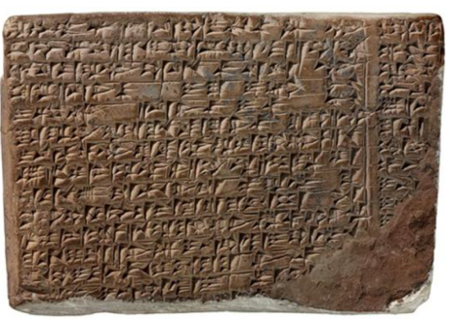
Tablet Inscribed in Akkadian with a Fragment of the Epic of Etana. Mesopotamia, First Dynasty of Babylon. Clay MLC 1363 (ca.1895–1595 BCE) Cuneiform
The Enuma Elish
The Enuma Elish (The Seven Tablets of Creation) is the Mesopotamian creation book. It tells the mythology of civilisation and is in poetic form[9].
When in the height heaven was not named,
And the earth beneath did not yet bear a name,
And the primeval Apsu, who begat them,
And chaos, Tiamut, the mother of them both
Their waters were mingled together,
And no field was formed, no marsh was to be seen;
When of the gods none had been called into being,
And none bore a name, and no destinies were ordained;
Then were created the gods in the midst of heaven,
Lahmu and Lahamu were called into being…
Ages increased,…
Epic of Gilgamesh
Epic of Gilgamesh tells the story of the king of Uruk, Gilgamesh. We are told of his power, friendships, and pursuit of eternal life. The poem is written on twelve tablets in Cuneiform[10].
He who has seen everything, I will make known (?) to the lands.
I will teach (?) about him who experienced all things,
… alike,
Anu granted him the totality of knowledge of all.
He saw the Secret, discovered the Hidden,
he brought information of (the time) before the Flood.
He went on a distant journey, pushing himself to exhaustion,
but then was brought to peace.
He carved on a stone stela all of his toils,
and built the wall of Uruk-Haven,
the wall of the sacred Eanna Temple, the holy sanctuary.
Enheduanna, first woman.
Centuries before men like Homer, Plato, Cicero, and Quintilian there was Enheduanna. She was the first woman who wrote and was acknowledged for her authorship. Her epic poem A Hymn to Inanna is her most well-known piece. Enheduanna uses her expertise in persuasive, and instructional writing to further her cause in transcribing the power of her goddess Inanna and makes her argument that Inanna is the ultimate of all the deities, surpassing the male ones (the counterpart to Inanna being An), which were known to have the supreme of powers in Mesopotamia[11]/[12].
Magnificent queen who gathers the divine presence of heaven and earth
And rivals the great An,
The greatest among the gods, she validates their verdicts
The Anuna gods crawl at her magnificent word,
Its path An does not know, he does not go against her command.
She changes her plan, and no one knows it.
[1] Kern, R. (2015). Ancient writing in Mesopotamia. In (pp. 135–149). https://doi.org/10.1017/CBO9781139567701.007
[2] Regulski, I. (2016). The origins and early development of writing in Egypt.
[3] Schmandt-Besserat, D. (2014). The evolution of writing. Austin, Texas: University of.
[4] Schmandt-Besserat, D. (2014). The evolution of writing. Austin, Texas: University of.
[5] Regulski, I. (2016). The origins and early development of writing in Egypt.
[6] Ancientorigins. (2021). The Descent of Inanna into the Underworld: A 5,500-Year-Old Literary Masterpiece. https://www.ancient-origins.net/myths-legends/descent-inanna-underworld-5500-year-old-literary-masterpiece-007296
[7] Ancientorigins. (2021). The Descent of Inanna into the Underworld: A 5,500-Year-Old Literary Masterpiece. https://www.ancient-origins.net/myths-legends/descent-inanna-underworld-5500-year-old-literary-masterpiece-007296
[8] Foster, B. (1995). The Myth of Etana. https://www.mesopotamiangods.com/the-myth-of-etana/
[9] King, L. W. (1902). Enuma Elish: The Epic of Creation (Vol. 1). Library of Alexandria.
[10] Sanders, N. K. (1960). The epic of Gilgamesh. Assyrian International News Agency Books Online.
[11] Raign, K. R. (2019). Finding Our Missing Pieces — Women Technical Writers in Ancient Mesopotamia. Journal of Technical Writing and Communication, 49(3), 338–364. https://doi.org/10.1177/0047281618793406
[12] Krecher, J. a. J. (2021). A hymn to Inana (Inana C): translation. https://etcsl.orinst.ox.ac.uk/section4/tr4073.htm


Comments